In demanding industrial, agricultural, and off-road environments, lighting failure is a direct safety hazard that causes immediate operational downtime. When visibility drops on a job site, productivity halts. Operators and fleet managers face a choice between established halogen technology and modern solid-state lighting. The decision hinges on balancing power consumption, durability under heavy vibration, and environmental resistance.
This guide provides an objective, spec-by-spec comparison of these two lighting architectures. We detail performance metrics, implementation risks, and application-specific criteria. You will learn how to evaluate electrical loads, thermal management, and optical efficiency. By understanding these technical differences, you can select the correct lighting setup for your vehicles and equipment, ensuring maximum uptime and safety in the field.
Efficiency & Power Draw: LED technology produces significantly more lumens per watt, reducing alternator strain and allowing for more lights on a single circuit compared to halogen.
Vibration & Durability: The solid-state nature of LEDs eliminates the fragile filament found in halogen bulbs, making LEDs structurally superior for high-vibration environments like trucking, mining, and off-roading.
Thermal Management: Halogen lights convert up to 80% of their energy into heat, posing burn risks and wasting power, whereas LEDs utilize engineered heat sinks to manage thermal output efficiently.
Adverse Weather Performance: While cool-white LEDs provide superior contrast in clear conditions, lower color-temperature halogens or amber-tinted LEDs perform better in heavy dust, fog, and snow due to reduced backscatter.
Technical Comparison: Operating Mechanics
To understand the performance gap, we must examine the operating mechanics of both technologies. Halogen lights rely on a traditional incandescent process. Inside a glass envelope filled with halogen gas, electrical current passes through a tungsten filament. This current heats the filament until it glows. While this legacy design has been standard for decades, it possesses inherent physical limitations. The filament degrades over time. It generates extreme heat and remains highly susceptible to failure from mechanical shock. A sudden impact or sustained vibration easily snaps the fragile filament, resulting in immediate light failure on the job site.
Light Emitting Diodes operate on entirely different principles. They are semiconductors that convert electrical current directly into photons. They emit light without relying on heat. This solid-state technology lacks moving parts, fragile filaments, or delicate glass envelopes. The absence of these vulnerable components establishes the foundation of their high reliability. Because they generate light electronically rather than thermally, they offer a fundamentally more robust and efficient lighting solution for demanding environments. You do not have to worry about a bulb shattering when a stray rock hits the housing.
Feature
Halogen Technology
Solid-State Technology
Light Generation
Heated tungsten filament
Semiconductor diode
Primary Energy Output
Heat (up to 80%)
Light (Photons)
Vibration Resistance
Low (Fragile filament)
High (Solid-state design)
Housing Material
Glass envelope
Polycarbonate lens / Aluminum body
Core Performance and Evaluation Metrics
Energy Efficiency and Electrical Load
The efficiency gap between these technologies is substantial. We measure this primarily by lumen-to-watt ratios. A standard 55W halogen bulb produces roughly 800 to 1,000 lumens. This equates to an efficacy of about 15 to 18 lumens per watt. In stark contrast, an equivalent solid-state fixture produces 3,000 or more lumens while consuming a fraction of the wattage. They achieve efficacies of 80 to over 120 lumens per watt. You get significantly more light output for every unit of electrical energy consumed.
This efficiency directly impacts vehicle electrical systems. Multiple halogen fixtures draw high amperage. They place a heavy load on the battery and alternator. This leads to premature wear on charging components and potential battery drain, especially at idle. The minimal current draw of an equivalent LED work light array prevents these issues. Operators can run more lights simultaneously without overloading the electrical system. You ensure reliable vehicle operation even during extended nighttime shifts on remote sites.
Durability, Shock, and Vibration Resistance
In high-vibration environments like washboard roads, heavy agricultural machinery operation, or active mining sites, filament fragility is a major liability. The constant shaking and jarring cause the heated tungsten filament in halogen bulbs to weaken. Eventually, it breaks. This leads to frequent replacements. It increases maintenance time and leaves operators in the dark at critical moments when visibility is mandatory.
Solid-state reliability excels in these harsh conditions. A modern fixture mounted on a rigid, heavy-duty chassis eliminates filament breakage risks entirely. Manufacturers pot the internal components in epoxy or secure them against shock. This allows the lights to withstand severe impacts and continuous vibration. Many high-quality fixtures are tested against military-standard vibration ratings like MIL-STD-810G. They survive conditions that destroy a halogen bulb within hours of deployment.
Thermal Output and Operational Safety
Thermal management is a mandatory safety consideration on any job site. Halogen lights convert a massive portion of their energy into heat. Surface temperatures during prolonged operation reach up to 200 degrees Celsius. This extreme heat poses a severe burn hazard to operators. Mechanics or drivers may accidentally brush against the lens or housing during equipment operation or maintenance.
These high temperatures create significant risks in hazardous environments. In agricultural, forestry, and waste management settings, the intense heat of a halogen bulb can ignite combustible dust. It can ignite dry debris or spilled hydraulic fluids. Modern housings maintain significantly lower external profiles. They utilize engineered heat sinks to dissipate thermal output efficiently away from the lens. This lower operating temperature drastically reduces burn risks and the potential for accidental equipment fires.
Light Quality and Eye Fatigue
The quality of light directly affects operator performance and safety. Color Rendering Index measures the ability of a light source to render true colors. Both high-quality halogens and modern diodes offer good color rendering. This is critical for tasks like wire identification and reading safety signage accurately. However, the color temperature differs significantly between the two.
Halogens typically emit a yellowish hue around 3000 Kelvin. Modern diodes generally provide a daylight-white spectrum between 5000 and 6000 Kelvin. This cooler, brighter light mimics natural daylight. It significantly reduces operator eye strain and fatigue during long night shifts. However, cool-white light is susceptible to the Rayleigh scattering effect. When this light hits airborne particles like dust, fog, rain, or snow, it scatters. This causes reflective glare that reduces visibility. For adverse weather, lower-Kelvin halogens or selective yellow lenses are preferred to cut through the particulate matter.
Optical Efficiency and Beam Patterns
Raw light output is only part of the equation. How that light is directed determines its usefulness in the field. Halogen parabolic reflectors often suffer from inefficient, multi-directional light spill. They waste lumens outside the targeted work area. Modern fixtures utilize precise Total Internal Reflection optics to control the beam. They ensure maximum light is directed exactly where the operator needs it.
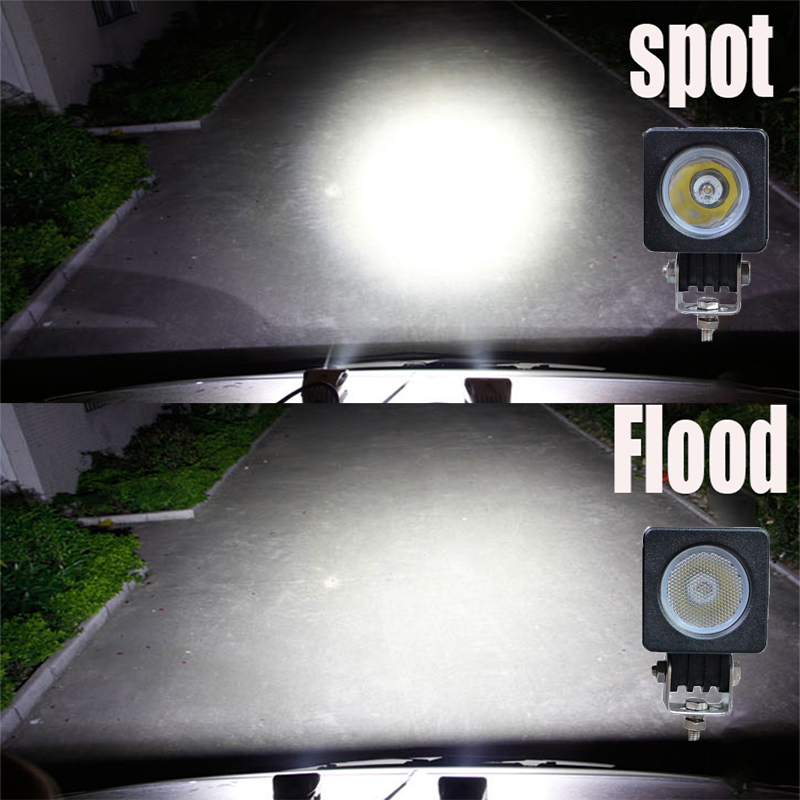
Lumens measure raw light output at the source. Lux measures usable light delivered to the target area. Because directional diodes control light more effectively, they deliver higher center-beam lux than halogens with the same lumen rating. Buyers must evaluate spot, flood, trapezoidal, and combo beam patterns to match specific spatial lighting requirements.
Spot beams provide long-distance visibility for high-speed driving.
Flood beams illuminate wide areas immediately surrounding the equipment.
Trapezoidal beams offer a compromise for general work areas.
Combo beams integrate multiple patterns into a single housing for maximum versatility.
Application-Specific Selection Criteria
Fleet Operations and Commercial Vehicles
Commercial vehicles face relentless demands on the road. Tow trucks, utility vehicles, dump trucks, and snowplows require robust lighting solutions. These lights must survive continuous use and harsh conditions. Implementing LED work lights for trucks addresses these heavy-duty road demands effectively. Fleet managers must prioritize DOT compliance where applicable. They must seek wide-voltage compatibility, typically 9V to 32V systems, to handle both 12V and 24V fleets seamlessly.
Environmental resistance is non-negotiable for fleet operations. Vehicles operating in winter conditions are constantly exposed to road salt and de-icing chemicals. Lighting fixtures must feature corrosion-resistant housings. Anodized aluminum or heavy-duty powder-coated finishes prevent degradation. The elimination of frequent maintenance intervals significantly improves fleet readiness and reduces operational disruptions.
Off-Road, ATV, and Powersports
Powersports vehicles operate under strict power-budget constraints. Their small stators and alternators cannot support the heavy electrical load of multiple halogen lights. If you overload the system, you drain the battery and strand the vehicle. Solid-state technology is essential in this sector to provide maximum illumination with minimal power draw.
Modular auxiliary lighting is highly effective for these applications. Integrating a compact Square ATV Additional 10W LED Work Light provides targeted ditch, spot, or reverse lighting. It does this without overloading the vehicle charging system. Off-road environments demand high impact resistance. Fixtures must utilize polycarbonate lenses rather than glass to prevent breakage from flying trail debris, rocks, and low-hanging branches.
Form Factors and Spatial Constraints
The physical footprint of a lighting fixture dictates where you can mount it. Traditional halogen housings are often bulky and deep. They need space to accommodate the bulb and reflector. This limits installation options on modern, aerodynamically styled or space-constrained equipment. Solid-state technology allows for modern, low-profile designs that fit into tight spaces.
Flush and recessed mounting options are highly desirable. They maintain a clean vehicle profile and protect the light from impacts. A Square LED Work Light is particularly versatile for flush-mounting into bumpers, headache racks, utility boxes, or tight equipment enclosures. When evaluating form factors, consider the mounting hardware. Bracket materials should ideally be 316 stainless steel to resist corrosion. The inclusion of vibration-isolation dampers extends the life of the fixture on heavy machinery.
Conclusion
Calculate your vehicle alternator capacity to determine the maximum safe electrical load for new lighting fixtures.
Select polycarbonate lenses and heavy-duty aluminum housings for equipment operating in high-impact or corrosive environments.
Match the beam pattern to your specific application, using flood beams for close-range work and spot beams for distance visibility.
Install vibration-isolation dampers on all mounting brackets to protect the fixtures from severe mechanical shock.
FAQ
Q: Can I replace my existing halogen work lights directly?
A: Yes, you can usually replace halogen lights directly. Solid-state fixtures draw less current, so your existing wiring and relays are sufficient. Ensure the new fixtures are compatible with your vehicle voltage system.
Q: Why do some lights cause radio interference?
A: Low-quality fixtures may lack proper electromagnetic interference shielding in their internal circuitry. This causes static on two-way radios or CBs. Look for fixtures that are CISPR 25 or FCC compliant to prevent these issues.
Q: Are cooler color temperatures better for driving in snow?
A: Standard cool-white lights cause severe glare in snow and fog due to backscatter. For these conditions, use lights with amber lenses or a lower color temperature around 3000K to cut through the precipitation.
Q: How do I know if a light is truly waterproof?
A: Check the Ingress Protection rating. An IP67 rating means the light is protected against dust and temporary submersion. For extreme environments, look for an IP68 or IP69K rating, indicating protection against continuous submersion and high-pressure water jets.
Q: Do these lights need to warm up before reaching full brightness?
A: No, they provide instant illumination. They reach full brightness immediately upon being switched on, regardless of the ambient temperature on the job site.
Shenzhen Creek Optoelectronic Technologies Co., Ltd. produce Car LED work lights, off-road LED light bar, forklift safety lights, agricultural tractor work lights, LED strobe and beacon lights, car radios, etc.