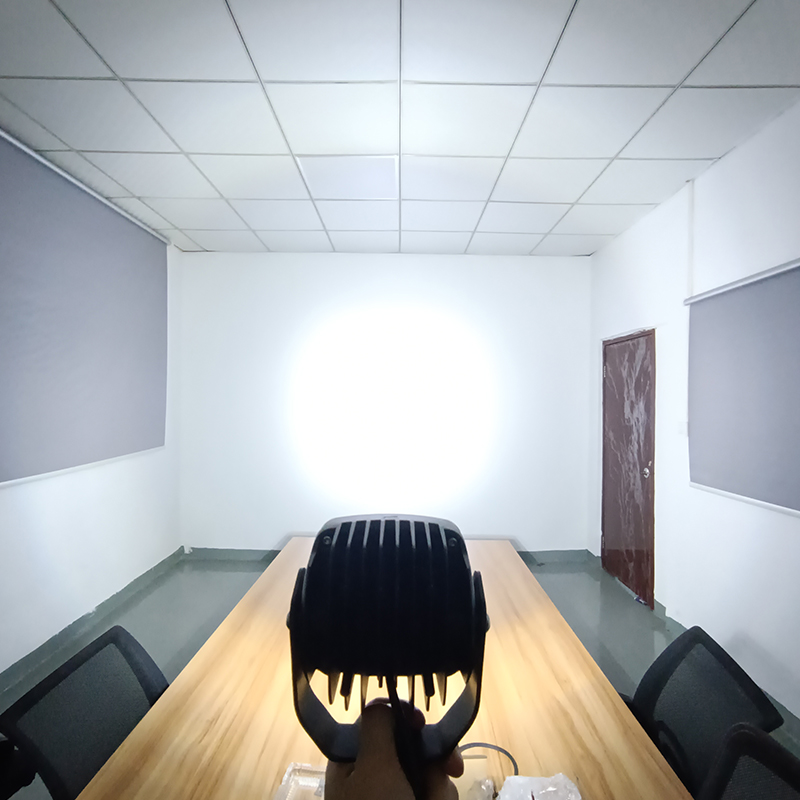
Selecting the wrong beam pattern for an outdoor or industrial space causes severe glare, wasted energy, and compromised safety. Buyers frequently confuse total lumen output with effective light distribution. A high-lumen fixture with the wrong beam angle will either wash out a targeted subject or fail to illuminate a wide perimeter. This mismatch leads to costly re-installations and inadequate lighting compliance.
Resolving this requires a technical understanding of beam angles, candela versus lumens, and application-specific requirements. You cannot simply buy the brightest fixture and expect good results. You must match the light dispersion to the physical environment. This guide breaks down the exact performance differences between an LED flood light and a spotlight. We provide a framework to specify the right fixture—or combination of fixtures—for commercial, residential, and industrial environments.
Key Takeaways
Beam Angle Dictates Application: Spotlights utilize narrow beam angles (typically under 45 degrees) for intense, focused illumination over long distances, while an LED flood light uses wide angles (up to 120 degrees or more) to cast light across broad, short-range areas.
Intensity vs. Coverage: Spotlights prioritize high candela (peak intensity) for penetrating distance; floodlights prioritize total lumen output for uniform area saturation.
Professional Setups Require Both: Rather than choosing just one, advanced lighting designs often layer floodlights for base coverage and spotlights for focal points.
Hybrid Solutions Exist: For dynamic environments like job sites or off-road vehicles, combination fixtures (like an LED spot flood work light) offer both localized width and down-range visibility.
Mitigate Implementation Risks: Proper selection must account for mounting height, light trespass regulations, and thermal management to ensure optimal performance and compliance.
Understanding the Core Difference: Beam Angle and Light Distribution
The Physics of an LED Flood Light (Broad Coverage)
A floodlight distributes illumination across a wide area. The standard beam spread typically ranges from 45 degrees to over 120 degrees. This wide dispersion pattern effectively reduces harsh shadows. It creates uniform visibility over large square footage. You will often see these fixtures mounted on building exteriors, stadium poles, and parking lot structures where broad visibility is the primary goal.
This broad coverage comes with a specific trade-off. Light intensity drops off rapidly over distance. This follows the Inverse Square Law of light. As the distance from the light source doubles, the intensity of the light decreases to one-quarter of its original strength. Because a wide fixture spreads its lumens over a massive area, it cannot push usable light very far downrange. It excels at close-to-medium range saturation. If you attempt to illuminate a fence line 200 feet away with a 120-degree beam, the light will dissipate into the atmosphere long before it reaches the target.
The Mechanics of an LED Spotlight (Focused Intensity)
A spotlight operates on the opposite principle. It features a standard beam spread typically between 10 degrees and 45 degrees. Manufacturers achieve this by using specialized optics, Total Internal Reflection (TIR) lenses, and deep reflectors. These components collimate the light. Collimation gathers the scattered light rays and forces them into a tight, concentrated beam, preventing the light from spilling out to the sides.
The primary advantage here is distance. A spotlight projects light across significant distances without losing target illumination. The lumens remain tightly packed. This prevents the light from washing out into the surrounding environment. You use this mechanic when you need to highlight a specific architectural detail, illuminate a distant flag, or see far down a dark trail. The tight beam maintains its punch, delivering high lux levels to a small, specific target area.
Success Criteria: Framing Your Lighting Problem
Calculating Area and Distance Requirements
You must measure the target zone before selecting a fixture. Compare the width of the area against the distance from the mounting point. This spatial geometry dictates your beam angle requirement. Grab a tape measure or use a laser distance meter to map the site accurately.
Measure the total width of the target zone you need to illuminate.
Measure the exact distance from the intended mounting point to the center of the target.
Calculate the required beam angle using a manufacturer's photometric chart to match the spread to your measurements.
Identify potential physical obstructions like trees or machinery that might block wide beams.
Follow a simple rule of thumb for baseline planning. If you have a short distance and a wide area, you need a flood pattern. If you have a long distance and a narrow target, you need a spot pattern. Trying to force a spotlight to cover a wide loading dock will create intense hot spots and dangerous dark zones. Forcing a wide beam to reach a target 100 feet away will result in weak, unusable illumination.
Identifying the Primary Objective
Define success based on your specific use case. Lighting objectives generally fall into three categories. The first is perimeter security. Here, you need to identify movement across a large yard. Broad coverage is mandatory to prevent intruders from hiding in shadows. The second is task lighting. You might need to illuminate a specific workstation, a mechanical pump, or a machinery panel. This requires focused, shadow-free light that does not blind the operator.
The third category is architectural accenting. This involves highlighting building columns, signage, or landscape features. Your objective dictates your beam choice. Security demands wide visibility. Accenting demands tight control. Task lighting often requires a balanced approach depending on the workstation size and the precision required for the task.
Feature-to-Outcome Evaluation: Where Each Excels
Security and Perimeter Lighting
For security applications, the clear advantage goes to the wide beam pattern. Security cameras require even, broad illumination to capture clear footage. High-contrast lighting with deep shadows hides intruders and wreaks havoc on a camera's dynamic range. If a spotlight creates a massive hot spot in the center of the frame, the camera iris will close down, rendering the rest of the yard pitch black.
A wide beam eliminates blind spots across a property line. It triggers effectively with motion sensors. When a sensor detects movement, the resulting wide beam instantly saturates the entire zone. This startles trespassers and provides the broad visibility required for modern CCTV cameras to function properly at night. You want overlapping pools of light to ensure seamless coverage along fence lines and building perimeters.
Landscape and Architectural Highlighting
Landscape lighting is highly context-dependent. Spotlights provide precise control. You use them to graze brick textures, uplight narrow trees, or highlight signage. They do this without washing out the surrounding environment or shining into residential windows. Placing a 15-degree spot 12 inches from a stone wall highlights the mortar joints and creates visual depth.
Conversely, you need wider beams for larger subjects. Broad canopy coverage requires a wide angle. Expansive building facades also demand wide distribution. If you use a tight beam on a massive oak tree, you will only illuminate the trunk, leaving the branches in darkness. You must match the beam spread to the physical width of the target object to achieve a balanced, professional look.
Industrial and Job Site Applications
Job sites require careful evaluation. You will frequently deploy an LED flood work light for illuminating broad construction zones. Scaffolding, warehouse loading docks, and staging areas demand wide light. In these environments, peripheral vision is critical. Workers need to see trip hazards and moving machinery in their peripheral view.
Shadow reduction is paramount for safety. Wide beam angles fill in shadows caused by equipment and stacked materials. Multiple wide fixtures aimed from different angles will cross-illuminate a workspace, virtually eliminating dark spots. However, crane operators or workers inspecting deep elevator shafts will require focused, tight beams to penetrate the distance and see the load at the bottom of the drop.
Automotive and Off-Road Applications
Vehicle lighting requires specific beam patterns based on speed and terrain. An LED driving spotlight provides high-speed, down-range visibility. When traveling at 60 mph off-road, you must identify hazards early. A tight beam punches through the darkness hundreds of feet ahead of the vehicle, giving the driver adequate reaction time.
This contrasts sharply with slow-speed applications. Rock crawling or navigating tight wooded trails requires ditch lighting. Wide patterns illuminate the immediate sides of the vehicle. This allows drivers to see tire placement, deep ruts, and immediate obstacles. Using a spot pattern for rock crawling provides zero peripheral awareness, forcing the driver to guess where the edge of the trail is.
Layering Light: When Professional Setups Require Both
Professional commercial and landscape setups rarely rely on a single beam pattern. The advantage of using multiple patterns is comprehensive visibility. Relying solely on wide beams makes an area look flat, washed out, and visually uninteresting. Relying solely on tight beams creates a polka-dot effect of bright spots and pitch blackness, which is dangerous for navigation.
Lighting designers use a layering strategy. They use wide fixtures to establish a baseline of ambient safety lighting. This provides general navigation and security. They then layer tight beams over this base. The focused light draws the eye to specific architectural details, entryways, or operational focal points. This creates depth, safety, and visual hierarchy across the property.
The Hybrid Solution: LED Spot Flood Work Lights
When to Use a Combo Beam Pattern
Sometimes you cannot install multiple separate fixtures. Space, mounting locations, or wiring limitations require a single unit. This is where combo lights excel. The architecture of these fixtures combines both optics into one housing. The outer LEDs typically feature wide, fluted reflectors to scatter light sideways. The inner LEDs utilize smooth, deep reflectors or TIR lenses to punch light forward.
Identify ideal scenarios for this hybrid approach. Heavy machinery, emergency response vehicles, and versatile job sites benefit greatly. An LED spot flood work light provides both distance penetration and peripheral lighting simultaneously. A tractor operator can see the end of the field to maintain straight rows while also illuminating the implement directly behind the cab to monitor performance.
Trade-offs of Hybrid Lighting Systems
Combo systems require compromises. A hybrid fixture will not throw light as far as a dedicated, specialized spot fixture. It will also not cover as wide an area as a dedicated, specialized wide fixture. You are splitting the available lumens between two different tasks. If you buy a 10,000-lumen combo bar, roughly half the output goes to distance and half goes to width.
Evaluate power draw and thermal load considerations. Running dual-optic systems in a single housing generates significant heat. The fixture must power multiple high-output LED chips simultaneously. Ensure your electrical system can handle the amperage draw, especially on 12V or 24V mobile applications. Always check the wire gauge requirements and use properly rated relays before installation to prevent electrical fires or voltage drops.
Technical Evaluation Dimensions for Procurement
Lumen Output vs. Candela
Buyers often misunderstand lighting metrics. Lumens measure the total visible light emitted by a fixture in all directions. Candela measures the intensity of that light in a specific direction. Think of lumens as the volume of water flowing from a hose, and candela as the pressure when you put your thumb over the nozzle to spray it across the yard.
This explains why a 5,000-lumen spotlight will appear vastly brighter on a specific target than a 5,000-lumen wide fixture. The wide fixture spreads those 5,000 lumens over a huge area, diluting the intensity. The tight fixture concentrates all 5,000 lumens onto a small circle. You must evaluate candela when distance is your primary requirement.
Metric
What It Measures
Best Used For Evaluating
Lumens (lm)
Total volume of visible light emitted by the source.
Overall fixture power and broad area saturation capability.
Candela (cd)
Peak intensity of light in a specific, focused direction.
Distance penetration and target highlighting effectiveness.
Lux (lx)
Amount of light actually hitting a specific surface area.
Task lighting compliance and ground-level visibility.
Beam Angle (°)
The angle at which light is distributed from the fixture.
Coverage width versus throw distance requirements.
Mounting Height and Angle Adjustability
Mounting height directly impacts performance. Wide fixtures require higher mounting points to maximize their broad beam spread. If you mount them too low, the light hits the ground immediately, wasting the wide angle and creating a massive hot spot directly under the fixture. A height of 15 to 25 feet is standard for commercial area lighting, parking lots, and large yards.
Tight beam fixtures can be mounted lower if aimed precisely. Ground-level mounting works well for flagpoles, tree uplighting, or facade grazing. Regardless of height, you need adjustable trunnion (U-bracket) or knuckle (threaded pipe) mounts. Field calibration is always necessary. You must physically tilt and pan the fixture during installation to put the light exactly where it belongs and lock it down securely.
IP Ratings and Environmental Compliance
Outdoor and industrial fixtures face harsh conditions. You must verify the Ingress Protection (IP) ratings before procurement. An IP65 rating means the fixture is protected against dust and low-pressure water jets. This is suitable for general outdoor building mounts under eaves or on poles.
An IP67 rating provides protection against temporary submersion in water. You need this for heavy-duty off-road vehicles, marine environments, or areas prone to heavy flooding. For extreme industrial applications, look for IP69K, which withstands high-pressure, high-temperature washdowns. Never install a fixture outdoors without verifying its IP rating. Moisture ingress is a leading cause of premature LED failure and electrical shorts.
Implementation Risks and Mitigation
Light Trespass and Glare Management
Wide beam angles present a significant risk of light trespass. This occurs when light spills into neighboring properties or shines directly into residential windows. It can also blind oncoming traffic if mounted near a roadway. Glare creates dangerous conditions for drivers, pedestrians, and heavy equipment operators.
Mitigate this by using physical modifiers. Install glare shields, visors, or barn doors on the fixtures. These metal flaps block light from spilling backward or sideways. Precise aiming is also critical. Always angle wide fixtures downward. Never point them horizontally across a property line. Keep the tilt angle below 45 degrees from vertical to push the light toward the ground.
Zoning Laws and Dark Sky Compliance
Violating local ordinances regarding light pollution carries heavy fines. Many municipalities strictly regulate outdoor lighting. They aim to reduce skyglow, prevent glare, and protect nocturnal wildlife. Ignorance of these laws is not a valid defense during a building inspection or when a neighbor files a complaint.
Mitigate this risk through careful selection. Choose fixtures with proper cut-off angles. A full cut-off fixture emits zero light above the horizontal plane. Evaluate the BUG rating (Backlight, Uplight, Glare) to ensure it meets local codes. Select warmer color temperatures. Many codes require 3000K or lower to minimize blue light scattering in the atmosphere. Look for fixtures with Dark Sky Approved certifications.
Thermal Management and Fixture Longevity
Heat is the enemy of LED technology. High-output fixtures generate substantial thermal loads at the diode junction. If this heat cannot escape, the LED chips will degrade rapidly. This leads to premature failure, severe color shifting, and permanently reduced lumen output over time.
Mitigate thermal risks prior to purchase. Evaluate the heat sink design. Look for deep, exposed fins that maximize surface area for passive cooling. Ensure the housing material is heavy-duty die-cast aluminum, which conducts heat efficiently away from the internal boards. Always check the manufacturer's specified operating temperature ranges to ensure they match your local climate, especially in extreme desert or arctic environments.
Conclusion
The choice between a wide beam and a tight beam is dictated entirely by the spatial geometry of the target area and the specific visual task required. Neither is universally better. Professional setups often require both to achieve comprehensive, safe, and effective illumination across a site.
Take the following next steps to finalize your lighting plan:
Audit the installation site with a laser measure to determine exact throw distance and coverage width requirements.
Check local municipal codes for light trespass ordinances, BUG rating requirements, and color temperature restrictions.
Select fixtures based on a combination of beam angle and candela, rather than relying solely on total lumen output.
Specify adjustable mounting brackets to allow for precise field aiming during final installation.
Install physical glare shields if the fixtures will be mounted near property lines or active roadways.
FAQ
Q: What is the main difference between a spotlight and a floodlight?
A: The main difference lies in how they cast light. Spotlights utilize a narrow, concentrated beam under 45 degrees to push light over long distances. Floodlights use a wide, dispersed beam to provide broad coverage over a shorter range.
Q: Can I use an LED flood light for a driveway or landscape?
A: Yes. Wide fixtures are ideal for driveways and large tree canopies due to their broad coverage. However, they must be mounted high enough and angled downward to avoid blinding drivers or causing light trespass into neighboring windows.
Q: What is an LED spot flood work light?
A: It is a hybrid fixture that combines both narrow and wide optics in a single housing. This design provides both distance penetration and peripheral lighting simultaneously. It is ideal for construction sites, heavy machinery, and off-road vehicles.
Q: How many lumens do I need for an outdoor LED flood work light?
A: Lumen requirements depend on square footage and the task. A small patio might need 1,500 lumens, while a commercial loading dock may require 20,000 lumens. Remember that beam spread affects perceived brightness; wider beams require more lumens to maintain intensity.
Q: When should I use an LED driving spotlight instead of a light bar?
A: Driving spotlights are best for high-speed, long-distance visibility where you need to see far down a road or trail. Light bars typically provide a broader, shorter-range combo pattern better suited for slower speeds and peripheral awareness.
Q: Do floodlights consume more power than spotlights?
A: Power consumption is based on the fixture's wattage, not its beam pattern. A 50W spot and a 50W flood consume the same power. However, wide fixtures often require higher wattages to adequately illuminate large areas compared to targeted lighting.
Shenzhen Creek Optoelectronic Technologies Co., Ltd. produce Car LED work lights, off-road LED light bar, forklift safety lights, agricultural tractor work lights, LED strobe and beacon lights, car radios, etc.