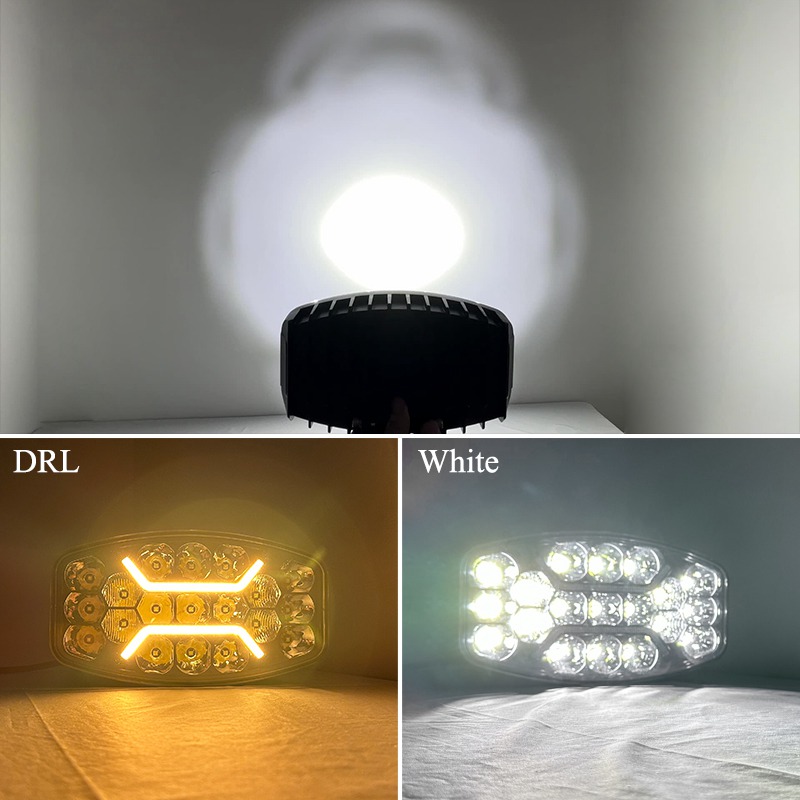
Navigating dense fog presents a severe operational hazard for heavy equipment operators and off-road drivers. Standard high-intensity lighting actively degrades visibility in these conditions. It creates a dangerous visual barrier rather than illuminating the path ahead. We call this phenomenon back-glare. Microscopic water droplets suspended in the air reflect high-Kelvin light directly back at the operator. This renders standard equipment completely ineffective and creates massive safety liabilities across commercial, industrial, and off-road applications.
To defeat fog glare, you must shift your focus. Stop buying brighter lights. Instead, specify the correct optical parameters for the environment. Color temperature (Kelvin) and beam architecture serve as your primary technical levers. You will learn how to manipulate these variables to cut through dense moisture. Choosing the right spectrum and optic design ensures you maintain operational safety when weather conditions deteriorate.
Key Takeaways
Lower Kelvin is Mandatory for Fog: Color temperatures between 2400K and 3000K (amber/yellow) minimize back-glare and maximize contrast in high-moisture environments.
Brightness Does Not Equal Visibility: Increasing lumen output with cool white light (5000K+) in fog only amplifies reflection; contrast, wavelength, and optical control are the true metrics of success.
Beam Pattern and Placement Matter: Even the optimal color temperature will fail if a flood beam is mounted too high or lacks proper lens technology; low mounting is required to undercut the fog layer.
Hybrid Solutions Exist: Dual-zone setups utilizing an amber DRL LED work light alongside standard white lighting provide operational flexibility for unpredictable weather.
The Physics of Fog and LED Flood Light Performance
Defining the Problem (Success Criteria)
Good visibility in fog requires more than raw brightness. You must evaluate contrast enhancement, depth perception, and light scatter reduction. High-moisture environments destroy depth perception. They blend objects into a uniform gray background. Success means restoring visual boundaries. An effective lighting setup highlights the edges of obstacles. It allows operators to judge distances accurately. Achieving this requires controlling how light interacts with suspended water.
When you operate heavy machinery or drive off-road, you need to see the exact edge of a trench, the shoulder of a logging road, or the outline of ground personnel. Fog removes these visual cues. Your lighting must cut through the moisture to hit solid objects and reflect that specific shape back to your eyes. If the light hits the water droplets and scatters before reaching the target, you fail.
The Science of Light Scatter
Fog consists of tiny liquid water droplets. These droplets trigger a phenomenon known as Mie scattering. Mie scattering occurs when particles are similar in size to light wavelengths. Physical water droplets scatter light equally across all wavelengths. However, the human eye does not process all scattered light equally. High-frequency blue light scatters violently. The human eye perceives this blue-heavy scatter as a blinding white wall.
This intense reflection forces the pupils to constrict. Pupil constriction immediately destroys natural night vision. Once your pupils shrink, you lose the ability to see into the darker areas outside the immediate beam pattern. You become blind to the periphery. This creates a tunnel vision effect that severely limits reaction time.
Wavelengths and Visual Acuity
Longer wavelengths perform differently in the human eye. Yellow and amber light sit lower on the visible spectrum. The human eye processes these longer wavelengths with greater ease. Amber light reduces the harsh glare reflecting off water droplets. It improves edge contrast significantly. Operators experience much less eye strain. They can identify shapes and hazards faster.
This holds true even when the overall lumen output is lower. Visual acuity depends on contrast, not absolute brightness. Controlling the wavelength directly dictates how well you see through the mist. When you filter out the blue spectrum, you remove the primary source of visual fatigue. Your eyes stay relaxed. You maintain better situational awareness over a twelve-hour shift in poor weather.
Evaluating Color Temperatures (Kelvin) for Fog Penetration
2400K – 3000K: Amber and Deep Yellow (The Gold Standard)
Deep amber excels in heavy particulate and moisture conditions. A 2400K to 3000K spectrum cuts through dense water droplets effectively. It produces minimal back-glare. Operators can see the ground and surrounding obstacles clearly. This temperature range dominates marine applications, heavy winter operations, and early morning agricultural work.
You must consider the primary trade-off. Maximum glare reduction comes at the cost of color rendering index (CRI) accuracy. Amber light washes out natural colors. Greens, reds, and blues appear muted or brown. You sacrifice color accuracy for penetration. This makes 2400K ideal for dedicated fog environments. Use it when seeing the physical outline of a hazard matters more than identifying its exact color. If you need to read color-coded warning signs, you will struggle. But if you need to avoid driving a haul truck off a soft shoulder, amber is your best tool.
3500K – 4000K: Warm to Neutral White (The Hybrid Approach)
The 3500K to 4000K range offers a pragmatic compromise. It works well in mixed-weather environments. A 4000K light cuts through mild fog and rain efficiently. It produces less glare than daylight bulbs. At the same time, it maintains adequate color accuracy.
Operators enjoy better visual comfort for general work site illumination. Task-based operations benefit from this neutral spectrum. You can read signs and identify wire colors easily. The warmer tone feels natural and reduces the harshness associated with industrial lighting.
However, this hybrid approach has limitations. When fog density increases to severe levels, 4000K begins to fail. The white light component will eventually create noticeable back-glare in heavy mist. You cannot rely on it during a complete whiteout or a dense coastal marine layer.
5000K – 6500K: Cool White (The Liability in Fog)
Standard daylight-balanced LEDs fail catastrophically in fog. The 5000K to 6500K range contains massive amounts of blue light. This high blue-light content reflects aggressively off water droplets. It creates an impenetrable white wall effect directly in front of the operator.
This reflection causes severe physiological eye fatigue. Operators suffer from immediate spatial disorientation. They lose track of the horizon line and ground contours. Cool white light actively creates a hazard in high moisture. You should strictly reserve these color temperatures for clear-night operations. Never rely on 6000K fixtures when navigating dense fog or heavy snow. Turning them on in a storm will force you to stop moving entirely.
Comparing Specific LED Configurations for Fog
The Role of a White LED Flood Work Light in Mixed Conditions
Most sites require standard white lighting for the majority of their operations. A white LED flood work light maximizes task visibility on clear nights. It provides excellent color rendering and broad illumination. You need this performance for 90 percent of standard shifts. You cannot eliminate white light from your fleet just because it fogs occasionally.
The operational reality requires smart integration. You must place white floods on separate, isolated circuits. Operators need the ability to instantly disable them during fog events. Leaving a white flood active in fog overrides any amber lights you have running. The white back-glare will dominate the operator's vision. Independent switching prevents this dangerous scenario. Wire your white lights to a primary switch and your amber lights to a secondary switch. Never wire them to activate together on a single relay.
Amber DRL LED Work Light vs. Dedicated Fog Modules
You must understand the difference between positional visibility and active illumination. An amber DRL LED work light serves a specific purpose. Daytime Running Lights (DRLs) exist so others can see you. They use low-wattage chips to create a bright, glowing signature. They do not project light far down the road. They act as markers.
A dedicated amber flood module does the opposite. It uses high-output chips and deep reflectors. It projects intense yellow light forward to illuminate the environment. You use a DRL to mark your vehicle's position in the mist. You use a high-output amber module to actually see the path ahead. Do not confuse the two when specifying equipment. Buying a DRL to light up a dark road will leave you completely blind.
LED Fog Light with Flood Beam: Balancing Width and Penetration
Traditional fog lights utilize a strict horizontal cutoff line. This prevents light from shining upward into the fog. Flood beams, by definition, disperse light widely in all directions. Combining these concepts presents a technical contradiction.
An LED fog light with flood beam can be highly effective under strict conditions. It must feature engineered optics with a sharp upper cutoff. You must mount it below the operator's eye line. This setup illuminates the immediate foreground widely. It lights up ditches and road edges. Because of the upper cutoff, it prevents light from hitting the fog layer above the hood. Proper mounting height dictates the success of this wide-beam configuration. If you mount this hybrid light on a roof rack, it will fail instantly.
Key Evaluation Dimensions for Procurement
Beam Angle, Optics, and Mounting Height
A wide beam angle behaves predictably in fog based on its mounting height. Angles between 60 and 120 degrees spread light laterally. If mounted on a roof, this wide spread hits the fog immediately. It creates a massive glare shield.
Advanced lens technology solves this issue. Total Internal Reflection (TIR) lenses and specialized bead reflectors control wide flood patterns. They direct the light downward and outward. They prevent upward light bleed. You must mount fog-specific fixtures as low to the ground as possible. Fog rarely touches the ground perfectly. A physical gap usually exists between the dirt and the fog layer. Low mounting exploits this gap. It shoots light under the weather rather than into it.
Mounting Location
Beam Behavior in Fog
Glare Risk
Recommended Use
Roof / Headache Rack
Illuminates fog directly at eye level. Blocks forward vision.
Extreme
Clear weather only. Never use in fog.
A-Pillar / Hood Level
Moderate scatter. Reflects off hood into windshield.
High
Spot beams only. Avoid wide floods here.
Front Bumper
Projects under the fog layer. Highlights ground contours.
Low
Primary location for amber fog lights.
Lower Valance / Axle
Maximum ground penetration. Exploits the fog gap.
Minimal
Ideal for heavy equipment and snowplows.
Lumens vs. Lux vs. Usable Contrast
Procurement teams often chase raw lumen numbers. Raw lumens only measure the total light output at the source. They do not measure visibility. Lux measures the actual light reaching your target. In fog, usable contrast matters more than both.
Prioritize lux and real-world photometric testing over raw lumens. A 3000-lumen amber light will outperform a 10000-lumen white light in dense fog. The amber fixture provides usable contrast. The white fixture only provides blinding glare. Review the comparison table below to understand these metrics.
Metric
Definition
Performance in Fog
Procurement Priority
Raw Lumens
Total light energy emitted by the LED chips.
High lumens in cool white create severe back-glare.
Low. Do not buy based on lumens alone.
Lux
Intensity of light hitting a specific surface area.
Determines how well the ground is illuminated.
Medium. Look for high lux at low mounting angles.
Usable Contrast
The eye's ability to distinguish objects from the background.
Amber wavelengths maximize contrast by reducing scatter.
High. This is the true measure of fog visibility.
Beam Cutoff
The optical line where light stops projecting upward.
Prevents light from illuminating the fog layer above.
Critical. Requires TIR lenses or hooded reflectors.
To properly evaluate a light before deployment, follow these field-testing steps:
Mount the test fixture on a temporary magnetic base at bumper height.
Wait for a high-moisture event or simulate one using a commercial water atomizing cannon.
Place high-visibility cones at 50-foot intervals extending outward from the vehicle.
Activate the light and measure the exact distance where the cone edges blur into the background.
Compare the amber fixture against a standard white fixture to document the difference in usable contrast.
Environmental Durability and Compliance
Fog implies constant, penetrating moisture exposure. Your LED flood light must survive these conditions. IP67 and IP68 ratings are mandatory. They protect against temporary and continuous submersion. For heavy industrial use, demand IP69K. This rating ensures survival against high-pressure, high-temperature washdowns.
Thermal management plays a huge role in cold, wet conditions. Poorly sealed housings allow internal condensation. Condensation on the inside of the lens distorts the beam pattern. It scatters the light unpredictably. Ensure the fixture utilizes military-style breathers. These pressure-equalizing vents let Gore-Tex membranes push moisture out while keeping liquid water from entering. Without a breather, the heat cycle of the LED will eventually suck water past the silicone seals.
Implementation Risks and Conceptual Trade-offs
The Trade-off Between Fog Penetration and General Illumination
Over-indexing on 2400K amber lights carries operational risks. If you use deep amber for all tasks, you will experience poor visibility in clear conditions. The low CRI makes reading color-coded materials difficult. Unnatural color rendering can cause eye fatigue during long, clear-weather shifts. You cannot wire a complex electrical panel under amber light.
You must implement multi-zone lighting strategies to mitigate this risk. Do not rely on a single color temperature for all operational needs. Equip vehicles and sites with both amber and white fixtures. Train operators to switch between them based on immediate atmospheric conditions. This ensures optimal visibility regardless of the weather.
Scalability and Integration Challenges
Adding auxiliary amber lighting to existing equipment introduces wiring complexities. Factory electrical systems may not support additional high-draw circuits. Dashboard space for new switches is often limited. Improper wiring can lead to voltage drops or blown fuses. Splicing into factory harnesses voids warranties and creates fire hazards.
Utilize dual-color LED fixtures to solve integration challenges. These units switch between 6000K and 3000K using the factory wiring. Alternatively, install independent wiring harnesses. Use dedicated relays and fused distribution blocks. Run heavy-gauge wire directly from the battery to a standalone relay box. This provides seamless operator control without compromising the host vehicle's electrical architecture.
Conclusion
Audit your primary operating environment to determine the exact frequency of fog, snow, or heavy dust events before purchasing new equipment.
Select 2400K-3000K amber fixtures exclusively for low-mounted, forward-facing fog penetration tasks.
Review photometric data sheets to verify sharp upper beam cutoffs before authorizing the purchase of wide-angle fixtures.
Install independent switching circuits to separate cool white task lights from amber fog lights to prevent accidental glare.
Verify IP68 or IP69K ratings on all spec sheets to guarantee long-term survival in high-moisture environments.
FAQ
Q: What is the best color temperature for an LED flood light in fog?
A: The optimal range is between 2400K and 3000K. This deep amber or yellow spectrum minimizes light scatter. It reduces back-glare and significantly improves edge contrast, allowing you to see through dense moisture without blinding yourself.
Q: Why does a white LED flood work light cause glare in foggy conditions?
A: Cool white LEDs (5000K+) contain high amounts of blue light. Water droplets scatter this short-wavelength blue light aggressively. This creates a blinding white wall effect that reflects directly back into the operator's eyes, destroying night vision.
Q: Can I use an LED fog light with flood beam for highway driving?
A: You can only use it if it features a strict horizontal cutoff line. A standard flood beam will blind oncoming traffic. Ensure the optic design prevents upward light bleed and complies with local road regulations before highway use.
Q: Does a higher lumen count help an LED flood light penetrate fog better?
A: No. Higher lumens in a white light simply create more glare. Penetration relies on warmer color temperatures and precise optical control, not raw brightness. A lower-lumen amber light will always outperform a high-lumen white light in fog.
Q: What is the difference between an amber DRL LED work light and an amber flood light?
A: A DRL is a low-output marker designed so others can see your vehicle. An amber flood light is a high-output fixture designed to project light forward so you can see the environment. They serve completely different operational purposes.
Q: What type of reflector or lens technology is best for controlling flood beams in fog?
A: TIR (Total Internal Reflection) lenses are superior. They capture and direct nearly all emitted light, creating a focused pattern with a sharp cutoff. This prevents the upward light bleed that illuminates fog and causes glare.
Q: How high should I mount an LED flood light for optimal fog visibility?
A: Mount them as low to the ground as physically possible. Typically, this means on the lower bumper or below the grille. Low mounting undercuts the fog layer and prevents light from reflecting at eye level.
Shenzhen Creek Optoelectronic Technologies Co., Ltd. produce Car LED work lights, off-road LED light bar, forklift safety lights, agricultural tractor work lights, LED strobe and beacon lights, car radios, etc.