Upgrading from legacy halogen or HID setups to modern LED lighting completely transforms your night driving experience. However, the current aftermarket is heavily saturated. You will quickly encounter exaggerated lumen claims and cheap housings masquerading as premium professional gear.
Making the right choice comes down to securing actual operational visibility. You want to significantly reduce eye fatigue during those long night runs. You also need equipment tough enough to survive punishing, high-vibration off-road environments. Finally, any lighting upgrade must strictly match your truck's specific electrical capacity without overwhelming the alternator.
Choosing the right LED Light Bars requires moving beyond basic raw "wattage" metrics. You must actively evaluate advanced thermal efficiency, precise optical beam patterns, and practical mounting realities. This comprehensive approach guarantees a lighting system built for relentless trail performance.
Key Takeaways
True Output Matters: "e-lumens" (sustained output after 30 minutes of thermal buildup) is the only metric that matters, not theoretical raw watts.
Form Meets Function: A Curved LED Light Bar offers superior peripheral spread and follows modern truck aesthetics better than straight variants.
Zoned Coverage: Don't just buy the biggest bar; build a lighting system that targets specific visibility zones (e.g., immediate flood, mid-range combo, high-speed spot).
Compliance & Environment: Select ingress protection (IP67 vs. IP69K) and color temperatures (e.g., 5000K) based on your specific terrain and local off-road regulations.
Many buyers fall into a common trap. They assume higher wattage automatically equals better lighting. We need to dispel this outdated myth entirely. Premium top-bin LEDs, sourced from leading manufacturers like CREE or OSRAM, operate on a fundamentally different efficiency curve. They generate significantly more light while producing far less heat. By utilizing fewer watts to achieve maximum brightness, they actively protect your truck’s battery and alternator from unnecessary strain.
You must look beyond initial burst lumens. When a light powers on, it shines brightest for the first few minutes. Heat quickly builds up inside the housing. This triggers thermal throttling. The internal circuitry reduces power to prevent permanent chip damage. You should only evaluate "e-lumens" or effective lumens. This standard measures the sustained light output after 30 solid minutes of operation. Manufacturers providing e-lumen data demonstrate true transparency.
Color temperature drastically impacts your visual endurance. Human eyes evolved to process natural daylight optimally. Daylight sits around 5000K on the Kelvin scale. Therefore, 5000K is the objective sweet spot for off-road environments. It provides crisp terrain definition. It reduces harsh glare bouncing off dust. In contrast, 6000K or 7000K cold white lights look incredibly bright up close. Unfortunately, they cause severe eye strain over long distances. They wash out subtle trail details and create blinding reflections off rain and snow.
Off-road durability relies on strict ingress protection ratings. You cannot compromise on these standards if you tackle serious trails.
Protection Rating | Water Resistance Level | Best Use Case Scenario |
IP67 | Survives temporary submersion (up to 1 meter for 30 minutes). | Standard trail riding, shallow water crossings, heavy rain storms. |
IP68 | Survives continuous submersion beyond 1 meter under pressure. | Deep mud bogging, sustained river crossings, extreme overlanding. |
IP69K | Survives close-range, high-pressure, high-temperature commercial spray downs. | Commercial vehicles, heavy agricultural use, frequent pressure washing. |
Alongside strong IP ratings, you must verify the physical construction. Demand shatterproof polycarbonate lenses. Glass shatters too easily from kicked-up gravel. Furthermore, look for military-grade, oversized aluminum heat sinks. They ensure maximum thermal dissipation to keep those e-lumens stable.
Optic Technologies: Lenses, Reflectors, and Beam Patterns
Professional drivers use a structured framework to plan their lighting. They divide the trail ahead into specific lighting zones. Different terrains demand visibility in distinct areas. Understanding this helps you avoid buying useless lighting equipment.
Zone 1 (Immediate Front): Required for slow rock crawling and spotting immediate ditch hazards.
Zone 2 (Mid-Range Width): Required for cornering and illuminating the direct trail shoulders.
Zone 3 (Primary Driving Range): Required for standard speeds, replacing your factory high beams.
Zone 4 (High-Speed Penetration): Required for speeds exceeding 50 mph to spot distant obstacles.
Zone 5 (Extreme Distance): Required exclusively for high-speed desert racing and extreme wide-open terrain.
To illuminate these zones properly, you must select the correct beam variations. Each pattern serves a highly specific purpose.
Spot: These lenses feature a tight focus, often around a narrow 4-degree angle. They offer high penetration for high-speed driving. They push light aggressively into Zones 4 and 5.
Flood: These lenses provide massive wide-angle dispersion. They light up trail shoulders perfectly. They dominate Zones 1 and 2 for slow rock crawling and campsite work.
Combo: This remains the pragmatic choice for most truck owners. It mixes central spot penetration with peripheral flood coverage. It handles Zones 2 and 3 seamlessly in one unit.
Lens technology recently took a massive leap forward. A prime example is the 5D curved LED light bar optic system. Standard 3D or 4D reflectors often lose light. They scatter it into the night sky. The 5D technology solves this directly. It combines a deep reflector cup with an aggressive fisheye projector lens. The reflector captures every stray photon. The projector lens intensely focuses it. This drastically reduces light scatter. It pushes usable light significantly further down the trail.
Truck owners constantly debate between straight and curved designs. Each form factor presents unique mechanical and visual advantages.
Straight bars work best for perfectly flat mounting surfaces. You often see them mounted inside lower bumper openings or behind custom grilles. When selecting a straight bar, you must choose between single-row and double-row configurations. Single-row bars offer a sleek stealth look. They create minimal aerodynamic drag. Double-row bars deliver maximum raw output. However, they introduce higher wind resistance and a bulkier profile.
Alternatively, the curved form factor solves several inherent problems. It provides structural and optical advantages you cannot ignore.
| Comparison Chart: The Advantage of Curved Designs |
Evaluation Category | Why the Curved Design Excels |
Aesthetics | Matches the natural, sweeping contour of modern truck windshields and rounded front bumpers. It looks integrated, not bolted-on. |
Peripheral Spread | Naturally throws light at a wider arc. It illuminates ditches and sharp trail edges without requiring secondary ditch pods. |
Aerodynamics | Slightly reduces aggressive wind drag. It deflects airflow better, cutting down the annoying whistling noises common on highway drives. |
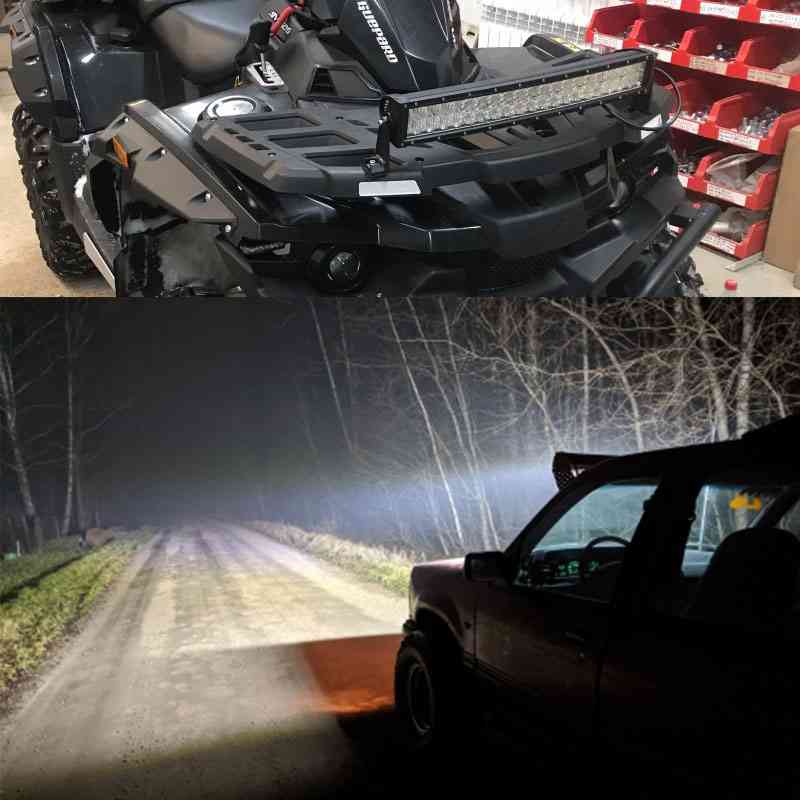
Integrating a Curved Led Light Bar into your build above the windshield practically eliminates blind spots on winding mountain trails. It casts a seamless blanket of light. You get superior peripheral vision exactly when you need it most.
Sizing, Placement, and Installation Realities for Trucks
Where you mount your lighting dictates its real-world effectiveness. A massive unit mounted in the wrong location performs poorly.
Roof mounts usually accommodate large 40-inch to 50-inch bars. They serve best for long-distance spot lighting. Because they sit high up, they throw light extremely far down the trail. However, you must heed a skeptical caveat. Roof mounts often create severe hood glare. This happens especially on light-colored trucks. The light reflects off the hood straight into your eyes. Furthermore, large roof units generate noticeable wind noise. They also present dangerous clearance issues if you frequently navigate heavily wooded trails with low-hanging branches.
Bumper and grille mounts typically utilize 20-inch to 30-inch units. These locations offer the highest return on investment. A bumper mount keeps your truck's center of gravity low. Because the light source sits closer to the ground, it cuts through dense dust and heavy fog much more effectively than a roof mount. Additionally, mounting up front drastically simplifies your wiring pathways. You do not have to drill through the roof or route cables down the A-pillar.
Speaking of wiring, you must carefully manage electrical draw. Stacking multiple high-draw accessories will destroy a stock electrical system. You must highlight the importance of heavy-duty wiring harnesses. Always use properly rated relays and dedicated inline fuses. Check your truck’s factory alternator capacity before adding a massive double-row unit. If you overload the system, you risk dangerous voltage drops.
Many modern setups now offer combo functionality for work and warning scenarios. These multi-function units feature independent amber or strobe sections. They cater perfectly to users who rely on their trucks for both weekend recreation and weekday commercial recovery work. You can light up a campsite in bright white, then flip to amber strobes when winching a stuck vehicle near a busy roadway.
Legal Compliance, Safety, and Next Steps
You cannot run high-output off-road lights on public highways. We must state this explicitly. Street legality requires that you cover or strictly disable these accessories on public roads. A 30,000-lumen blast will instantly blind oncoming traffic. This creates a serious legal liability. Police officers will issue heavy fines if they catch you running unshielded off-road gear in city limits.
Environmental conditions require adaptable lighting. Bright white light creates a blinding "white-out" wall when it hits heavy dust, falling snow, or thick fog. To combat this, you should utilize amber covers. Alternatively, invest in dual-control units. Amber light operates at a longer wavelength. It cuts through particulate matter instead of reflecting off it. This drastically improves safety in poor weather conditions.
Apply simple shortlisting logic to finalize your decision. Advise yourself to honestly audit your current visibility gaps. Do you constantly out-drive your headlights at high speeds? If so, prioritize a 20-30" bumper-mounted spot or combo unit. Do you prefer slow, highly technical forest trails? In that case, prioritize wide-angle floods. Match the hardware directly to your driving habits.
Conclusion
Upgrading your truck’s visibility transforms nighttime off-roading from a stressful chore into a highly enjoyable experience. Remember to move past the marketing hype.
Prioritize top-bin LED chips and verify real e-lumen output over raw wattage claims.
Always confirm reliable IP ratings (IP67 or IP69K) to ensure moisture and dust stay out of the housing.
Match the specific beam pattern and optical lens technology to your primary driving style and trail speeds.
Consider a curved design to maximize peripheral trail illumination and improve aesthetic fit.
Your next step is simple. Measure your available bumper or roof mounting space carefully. Review your truck’s electrical limits and alternator capacity. Once you establish those hard boundaries, you can confidently purchase the perfect lighting solution for your rig.
FAQ
Q: Can I run a 50-inch LED light bar without a secondary battery?
A: Yes, most modern trucks can power a single 50-inch unit using the factory alternator and primary battery. However, you must use a high-quality wiring harness with an appropriate relay. If you run multiple heavy-draw accessories simultaneously, upgrading your alternator or adding a secondary battery becomes necessary.
Q: What is the difference between a 4D and a 5D curved LED light bar?
A: A 4D setup uses a standard projector lens to focus light. A 5D system upgrades this by combining a deep reflector cup with a magnifying fisheye projector lens. This dual-action captures stray photons and significantly tightens beam control, pushing usable light much further down the trail.
Q: Why does my LED light bar whistle on the highway, and how do I fix it?
A: Whistling happens due to aerodynamic resonance. Wind hits the cooling fins at high speeds, creating high-frequency vibrations. You can fix this by installing rubber vibration dampeners between the cooling fins. Alternatively, adjust the mounting angle slightly to change the airflow, or relocate the unit behind the grille.
Q: Are double-row light bars always better than single-row?
A: Not always. Double-row units deliver maximum total lumen output, making them great for extreme environments. However, they create a bulky profile and generate heavy wind drag. Single-row units offer a stealthy, low-profile look with better aerodynamics, which many users prefer for daily-driven trucks.


